Sustainable Home Builder
Our sustainable construction expertise at your service
We build sustainable, high-quality custom homes designed for comfort. Whether you're looking for a turnkey, ready-to-finish house, or an accompanied self-build project, our offer is tailored to your needs.
Our homes are built with local, safe and durable materials and meet the highest quality standards. In addition to Novoclimat-certified projects, we build LEED or carbon-neutral homes. These rigorous quality standards, recognized throughout the industry, guarantee that your project has been inspected by an independent expert. Financial support is also available for Novoclimat certification.
As a general contractor, Belvedair is a member of the APCHQ and is fully accredited by Garantie GCR and the RBQ.
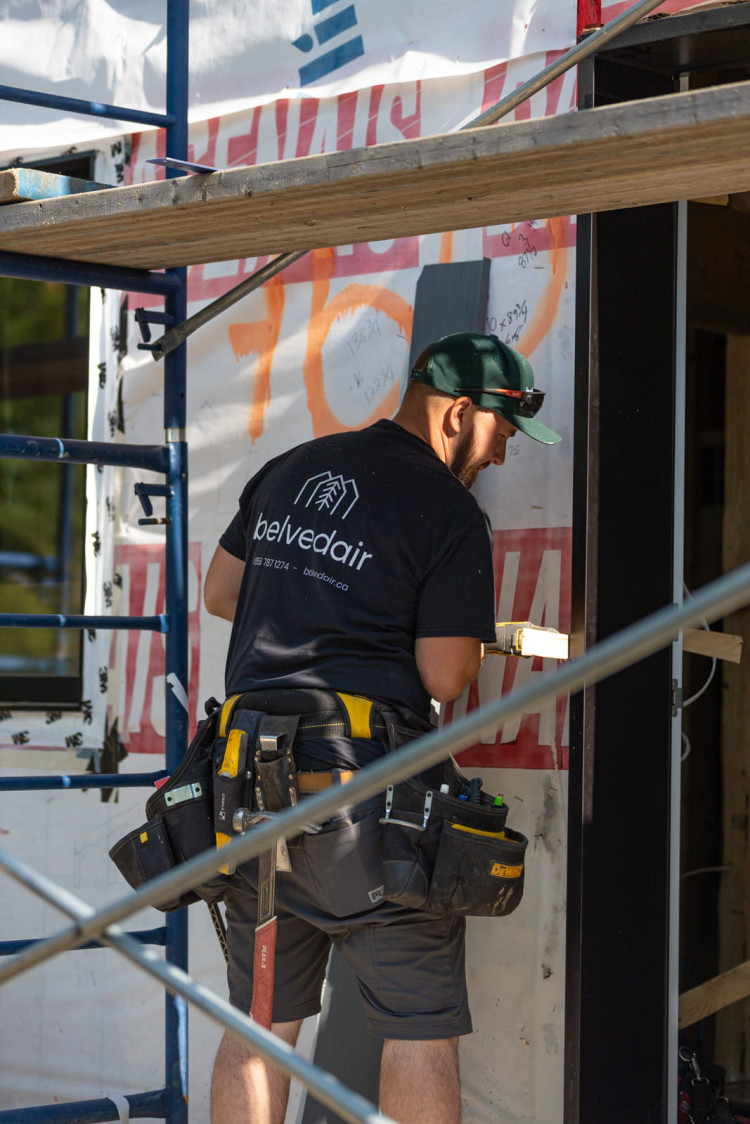
Our team is made up of passionate individuals who are recognized for their expertise and committed to advancing construction standards for sustainable, environmentally friendly homes.
Based in the Laurentians, Lanaudière, Montérégie and Eastern Townships, our experienced local site teams have complementary specializations, and each task has its expert! Your project is overseen by a team leader who works closely with a project manager, from start to finish.
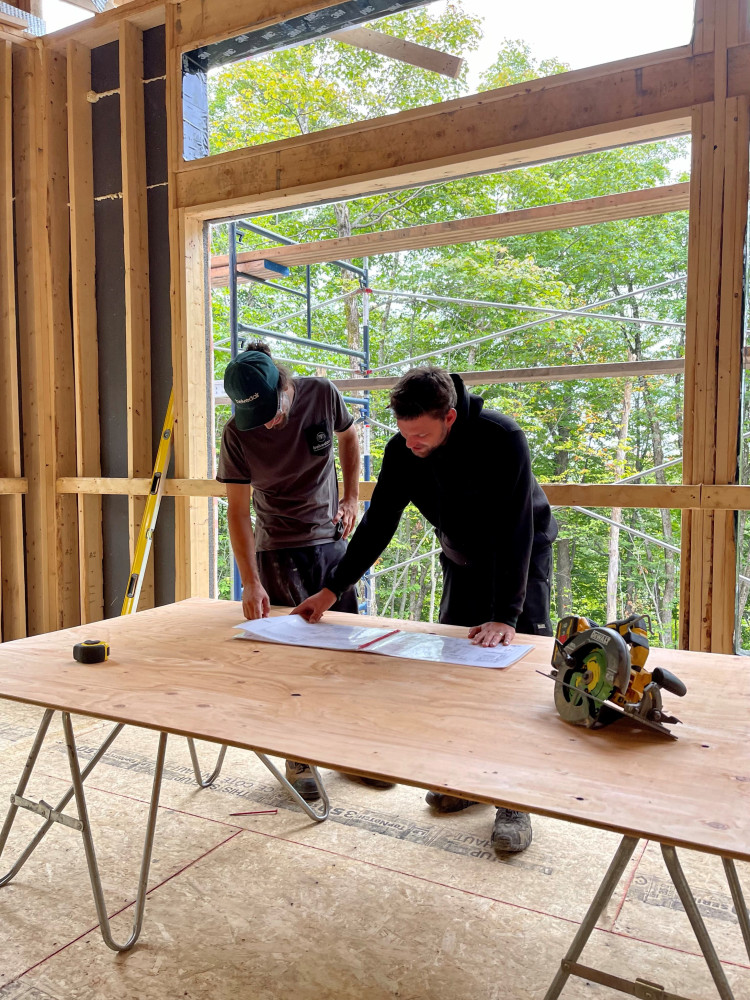
Belvedair builds environmentally friendly properties according to plans and specifications developed in-house with you, based on your needs. We know each project inside out, ensuring efficient exécution with a clear, reliable budget. We understand that building a home is a major undertaking and a considerable investment—you are more than welcome to ask questions at any stage!
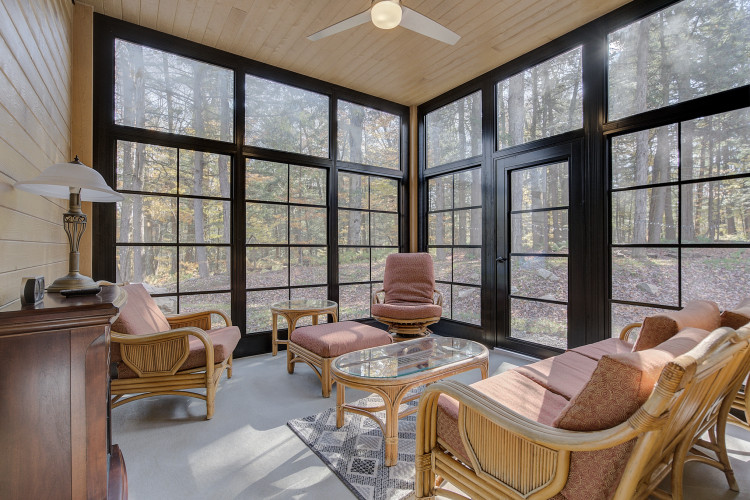
Our services include all the coordination required to prepare your site:
- Driveway
- Septic systems
- Excavation
- Water and electricity connections
We also monitor every stage of the construction process:
- Foundations
- Framework
- Insulation
- Waterproofing and mechanical systems
- Divisions
- Exterior cladding
We can also take care of your interior finishes and built-in furniture (optional).

- Novoclimat rebate of up to $4,000 when purchasing a property;
- Energy savings of up to 60% from the first month of occupancy;
- Depreciation is less rapid than with a standard construction;
- Financial advantages according to financial institutions;
- Potential municipal tax credits.

What is an ecological home?
There are several possible answers to this question. At the very least, an ecological home should consume less energy and water, ensure healthier air quality and use environmentally friendly materials. For those who want the very best, Belvedair has extensive experience in designing and building energy-efficient homes. See our Eco-Building Guide.
What is a passive solar house?
Passive solar means using the free, phenomenal energy the sun sends our way every day to heat our homes. We’re not talking about solar panels or technological add-ons here; rather, it’s about orientation, abundant windows and other well-designed features. With passive solar design, you’ll be able to live in a bright, comfortable place all year long, with significantly lower energy bills. Learn more
Is an eco-friendly home truly more sustainable?
Yes, an eco-friendly home is truly more sustainable, because sustainability depends on performance that is invisible yet real. Beyond healthy materials, it is the building’s high-performance envelope that makes the difference: better weatherproofing protects the structure from water and Quebec’s extreme weather conditions. This efficiency translates into significant energy savings and a reduced carbon footprint throughout the home’s entire life cycle. Choosing Belvedair means investing in a resilient building that retains its resale value while offering a superior quality of life.
How is sustainable construction better suited to Quebec’s winter climate than standard construction?
Unlike standard construction, a Belvedair sustainable home features superior insulation and exemplary airtightness. By utilizing bioclimatic design, we transform winter sunlight into a free source of heat: where a conventional home consumes energy to compensate for heat loss, the eco-friendly home capitalizes on passive solar gains, and its high-performance insulation conserves energy, providing constant comfort and drastically reduced Hydro-Québec bills.
Is an eco-friendly home easy to maintain?
Belvedair’s approach focuses on improving components that require little to no maintenance. For example:
- through better window orientation to take advantage of the sun’s free energy;
- through improved air and water tightness, which enhances energy efficiency and protects the building’s structure;
- through better insulation;
- through healthier interior finishes and more durable exterior finishes;
- through more efficient plumbing fixtures;
- through a more efficient heat-recovery air exchanger.
This approach differs from one relying on “mechanical” technologies, which require more maintenance, such as geothermal systems, for example. Although there are no “maintenance-free” homes, a Belvedair eco-home will require less maintenance than a “standard” home.
Is it possible to build an eco-friendly home on a limited budget?
Absolutely, affordability is at the heart of our mission. To help you realize your dream without compromise, we offer a catalog of eco-friendly house plans featuring optimized and affordable designs. For those who want to get more involved, our “Ready to Finish” package is an excellent option: it allows you to take on certain finishing tasks to reduce labor costs.
Why are homes built by Belvedair more performant than the competition?
Our secret lies in our ultra-high-performance thermal envelope and our obsessive attention to airtightness. A Belvedair home retains heat in winter and coolness in summer drastically more effectively than a conventional build, offering unmatched comfort.
What eco-friendly materials do you prioritize on your job sites?
We select durable, local, and healthy materials: cellulose insulation (recycled material), local framing timber, VOC-free finishes (volatile organic compounds) for indoor air quality, and low-maintenance exterior cladding.
Do you have any questions? Would you like to learn more about Belvedair?
Fill in this form and we’ll contact you shortly.